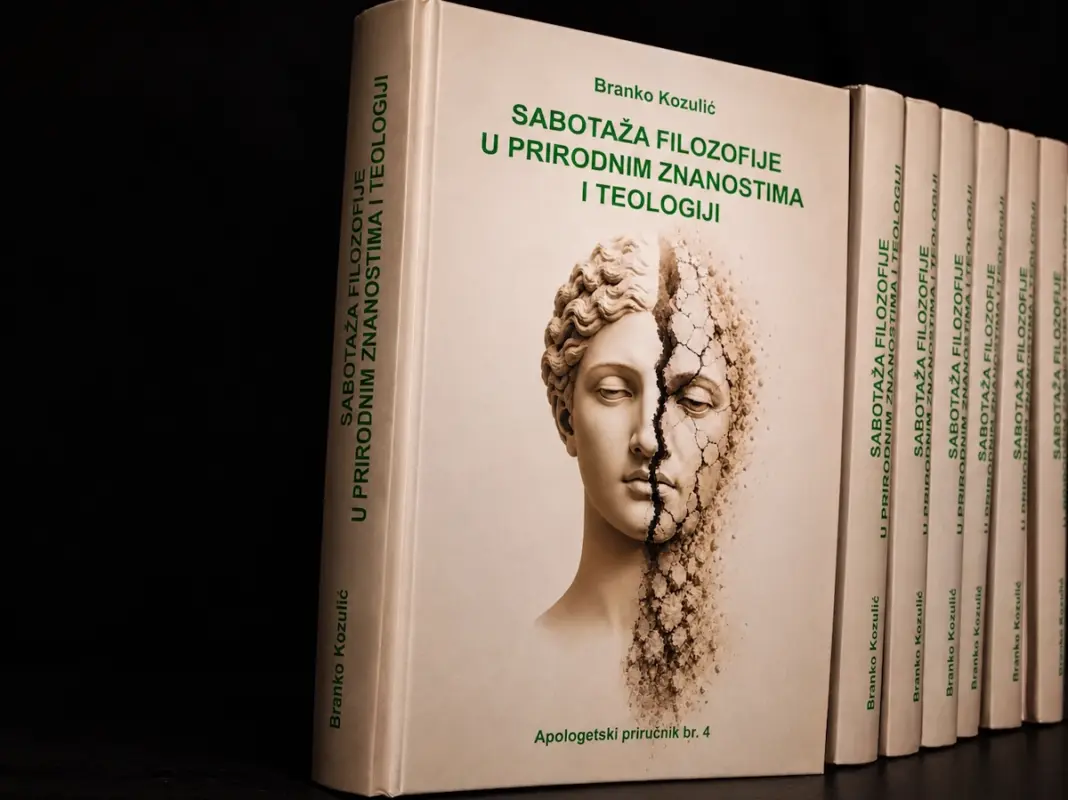
Dr. Branko Kozulić’s book Sabotaža filozofije u prirodnim znanostima i teologiji (Sabotage of Philosophy in Natural Sciences and Theology) was published in Croatian by the Apologetic Association of Blessed Ivan Merz from Zadar, in 2026. The book of 220 pages is the fourth volume of the Apologetic Handbook collection.
It is a fantastically refreshing interdisciplinary study at the intersection of theology, metaphysics, and the philosophies of biology, chemistry, and physics.
It marks the end of intellectual subordination to evolutionism, materialistic reductionism, and the return of essence to natural science and theology.
Dialectical materialism started from the claim that nature is in a state of constant profound changes and self-development through internal contradictions. However, from p. 39 onwards, Kozulić explains how modern insights into chemistry and molecular biology refute this and confirm the permanence, regularity and structures that point to the existence of essences.
Essence is that by which what is is, being without matter (Aristotle, Metaphysics , VII, 7); “that which is common to all natures by which various beings are classified into different genera and species” (Thomas Aquinas, On Being and Essence , I, 2); the first internal principle that enables something to exist; the basis from which the various properties of a thing arise and to which they necessarily relate; the abstract of concrete being; that which constitutes the permanent nature of something; the general that transcends the individual; the real and true that is not subject to changes in being; the reason or basis why it is precisely what it is. The essence is characterized by immutability, indivisibility, and necessity.
The main idea and purpose of the work
The destruction of the foundations of contemporary Christian civilization is not primarily a consequence of external attacks or church disagreements, but of the systematic sabotage of the love of wisdom (philosophy). This is the author’s central judgment. He explains how the acceptance and dominance of the philosophy of process (processism) – which teaches that everything in nature is in constant change and emergence – has destroyed the ontological and cognitive foundations of the exact sciences, morality and theology (especially with the emergence of modernism in theology).
Kozulić establishes a fundamental contradiction:
“the fundamental principle in all reality can be either existence (being, that which is, that which exists, persistence, things determined by their essence, being) or becoming (the process by which something becomes). Socrates opted for existence, as did his student Plato, and then Aristotle, in contrast to Heraclitus, who is the originator of the philosophy of becoming” (p. 16)
and throughout the book he refutes the idea that the world, at its deepest level, is composed of momentary events, rather than permanent material substances.
As an alternative to processism, Kozulić advocates the classical philosophy of essentialism, the view that things, people, or concepts have an innate, unchanging essence and that the resulting set of fundamental properties that make them what they are determine their identity. More precisely, Kozulić is a supporter of Aristotle’s and Aquinas’s essentialism, i.e. moderate realism. In contrast to ultimate realism (Platonic idealism) and nominalism (“there is nothing universal except the name”), moderate realism holds that universals exist in things themselves (and not in some separate world of ideas or exclusively in the human mind as a distinction, a mere naming).
Essence exists in the thing itself as its form (form, formula), and is fully realized by reason, which separates it from individual things as the generality of being. Essence also encompasses the dynamics of development specific to that species.
In his latest book, Kozulić proves that modern scientific discoveries (chemistry, biochemistry, genetics, physics) contradict the postulates of processism, and are consistent with the postulates of essentialism.
Natural sciences are not philosophically neutral in the sense that they could exist without any assumptions about reality, cognition, the identity of things, causality, and truth. Kozulić’s fundamental thesis is that modern physics, chemistry, and biology, properly philosophically interpreted, destroy processism and restore realism and essentialism.
The philosophy that reduces reality to an event (process), rather than an independent being (substance), was defeated by the completion of genome sequencing, and essentialism (Aristotle, scholasticism, Ruđer Bošković) was thereby restored as the “most contemporary philosophy” (pp. 185 and 198).
About the writer
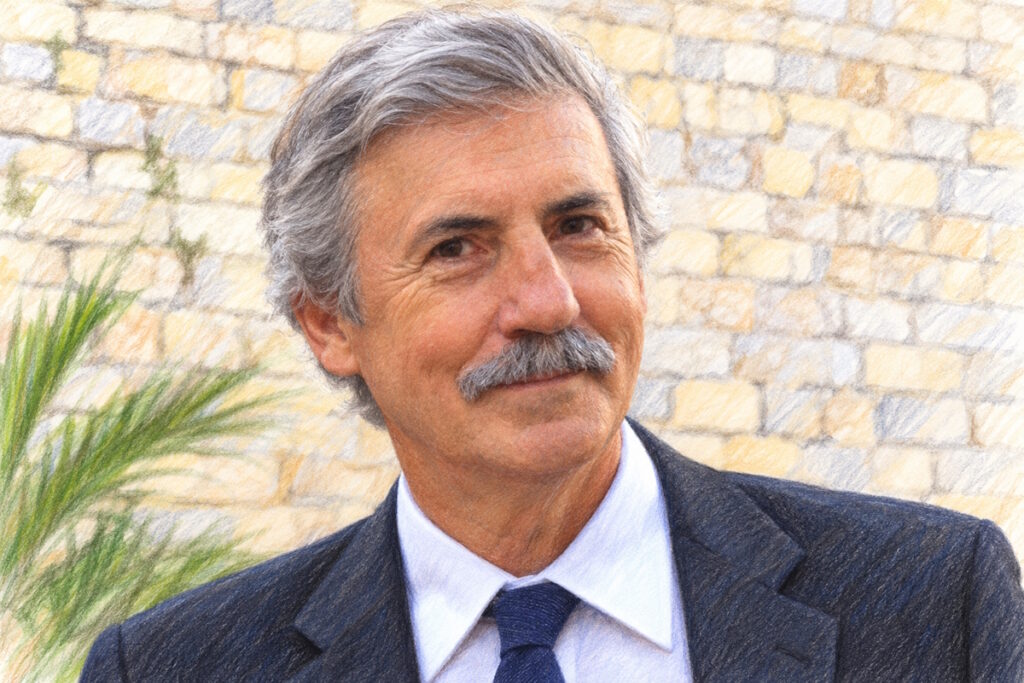
Dr. Branko Kozulić (1953) hails from the island of Ist near Zadar. He is a staunch Catholic, husband, father, grandfather, expert in organic chemistry and biochemistry, entrepreneur, emigrant and returnee, inventor and intellectual. With this book, he rounded off his lifelong preoccupation with the fact that natural science and philosophy seek truths about the world in which we live.
Kozulić has three main role models: the wise men Aristotle, Thomas Aquinas and Ruđer Bošković. All three of them combined the knowledge of the natural sciences of their time and incorporated them into their systems of thought, a comprehensive observation of the visible and the invisible. Like the three of them, the author explains how the knowledge of natural sciences (especially biology and chemistry) is inseparable and inexplicable without supernatural sciences (metaphysics), but, given that he lives in the 21st century, he also proves the benefit in the opposite direction, how contemporary knowledge of natural sciences, especially the results of genome sequencing, revive, evaluate, demonstrate the correctness and make permanently valid the teachings of the eternal philosophy (essentialism) from which he himself comes (p. 18).
Kozulić shows the reader that Aristotelian metaphysics is not a museum relic, but a philosophical language that can be applied to modern science. In fact, it is precisely this profound approach that is the most effective.
The greatest values of the book
The main feature of the book is that it reopens a question that has almost disappeared from popular debate: Which ontology best explains what the natural sciences actually discover? Dr. Kozulić argues that chemistry and molecular biology confirm essentialist ontology (the philosophy according to which every being has its own unchanging essence that determines what it truly is).
Another key value is that it refuses to take for granted that ‘evolution’ is (was) just a scientific theory without philosophical consequences.
In the Croatian context, it systematically connects Thomistic-Aristotelian ontology with current achievements in molecular biology for the first time.
The book should be acknowledged for a number of additional values: it innovatively combines biochemistry, physics, and eternal philosophy; it refutes the premise that everything changes; it destroys the myth of the evolution of species; it recognizes the genetic [1] program as the determinant of a living being; it makes genetics and the concept of genes clear; it refutes theological modernism and evolutionary theism, and it values the Croatian philosophical heritage.
An innovative fusion of biochemistry, physics and eternal philosophy
The greatest value of the book lies primarily in the completely fresh connection of biochemistry, physics, and scholastic philosophy. The author, a biochemist by profession and a philosopher by his method of argumentation, uses modern and exact natural scientific data to examine and refute the metaphysical theses of process philosophy.
It brings together several areas that are usually discussed separately: Aristotelian metaphysics, chemistry, molecular biology, evolution, information theory, intelligent design, scholastic theology, creation, and modernism. The content itself brings this arc closer: from ontology and logic through evolution and intelligent design to the soul and modernism.
An easy-to-remember example is how Kozulić precisely maps Aristotle’s concept of form (determinant, formative, external harmonious figure) into the field of chemistry and biochemistry, where the form of a chemical compound is its structural formula or structure (p. 22), and the form of a living being is its genetic program written in a molecule (or molecules) of deoxyribonucleic acid (p. 36). This demonstrates the concrete, meaningful correspondence between the concepts of philosophy and natural science.
In contrast to a single form of a compound or living being, a mixture (a mixture of at least two components that retain their essential characteristics even after mixing) can contain several different forms (p. 58).
This distinction is important because science does not only study “changes,” but also the identities of things that change. If everything is reduced to processes, the question arises: what is it that undergoes a process, that which changes, and yet remains a certain kind of thing? Change is an insufficient concept. Change is the change of something.
Refuting the dogma “Everything changes”
The book provides solid empirical evidence against Heraclitus’ and modernist’s proposition that everything is in constant flux, expressed in the saying Pánta rheĩ (Everything flows. / Everything changes).
Kozulić proves that the material world is primarily characterized by constancy (immutability), not an unstable flow, which is supported by the fact that elementary particles such as protons (whose lifespan is predicted to be 1030 years), electrons (1024 years) and photons (1018 years) have a lifespan that many times exceeds the current age of the universe itself, estimated at 1010 years (pp. 29–30).
Dynamism is consistent with essentialism, because mobility and liveliness are not core to the process, but rather to essence.
He does not claim “that nothing changes”, but “that some things do not change” (p. 31).
Despite their many differences, the common feature of processism – the philosophy of Fichte, Hegel, Nietzsche, Marx, Engels, James, Dewey, Sartre, Whitehead, Bergson, Teilhard, Kuhn and Rescher – is the idea that processes should have a fundamental place in the description of reality (p. 16).
Kozulić’s conclusion is that process ontology cannot simply abolish substances and replace them with relations or processes:
“In reality, relationships are important, but substances are more important, primary: without substances, relationships have nothing to refer to” (p. 39).
Debunking the myth of evolution
Since the comparison of the sequenced genomes revealed hundreds to thousands of proteins in each species without homologues in other species (“singletons”), the author offers the definition of the biological species :
“a biological species is a group of organisms that share at least 100 identical singleton proteins in each individual” (p. 114).
The key point is that from this definition it directly follows that the transformation of biological species, i.e. Darwinian evolution, is impossible.
The entire book ends with this conclusion:
“The revolution that has taken place in the sequencing of the genomes of biological species over the past thirty years has brought an enormous amount of data. From these data it follows that no new biological species could have arisen by any combination of chance and necessity. By eliminating chance and necessity, a third – sufficient and necessary – cause remains: Intelligence. This epochal result also means the final demise of Darwin’s theory of evolution, as well as the process philosophy dependent on it” (p. 197).
Genetic program as a determinant of a living being
Kozulić refuses to ignore the third component of reality – besides matter and spirit. He insists “on recognizing the existence of information in living beings that is independent of the existence of the human mind, and that is accessible to scientific research” (p. 108). He applies this third principle to the question of the soul (pp. 154–156) and to cognition when he writes that the validity of the definition of truth as adaequatio rei et intellectus (the correspondence of thing and mind):
“It involves three assumptions: 1) that the human mind is capable of knowing what a thing really is, that is, of knowing its essence, 2) that our mind is capable of formulating this knowledge, and 3) that our mind is capable of judging whether the formulation is adequate” (p. 46).
He establishes that information is not only in deoxyribonucleic acid, but also in ribonucleic acid, proteins, lipids, membranes, cell organs (organelles), metabolic pathways, and coordinating interactions, and that all of them are “harmonized parts of one complete, unique program that constitutes the essence of every living being” (p. 124).
Thus, he interprets biological information in terms of essence (ontologically).
“This [genetic] program is not material, but in its existence it depends on matter as its carrier” (p. 154).
Indeed, “structure” and “genetic program” can give new content to the classical concepts of form and essence, and by accepting these concepts, Aristotle’s philosophy of realism and essentialism “becomes the most contemporary” (p. 198).
Clarification of the concept of gene
The value of the work is also evident in the thorough demystification of genetics which is based on a misunderstanding of the term gene, by clearly distinguishing the role of proteins and deoxyribonucleic acid. In this, proteins are the real workers (agents), and deoxyribonucleic acid is the material carrier of information and has the role of the recipient (patient) (pp. 44–45). In doing so, the thinker points out the absurdity of anthropomorphic and modernist phrases such as the “selfish gene” or “gene action”, reminding us that sequences of nucleotides, like text or digital records, cannot perform any work by themselves.
On page 128, the book asks us: if a mathematically structured signal from space would be the reason to conclude about an intelligent sender (extraterrestrial intelligence), why not apply similar logic to genetic code, the fundamental rulebook used by all living things on Earth, and which has been proven to contain multiple mathematical relationships?
Critique of theological modernism and evolutionary theism
The second part of the book provides a critical analysis of the penetration of processism into Catholic theology, with special reference to the work of Croatian theologian Tonči Matulić (1966).
Kozulić brings to light how accepting a faulty philosophy inevitably leads to theological misconceptions about the non-existence of permanent truths and dogmas.
He exposes the transformation of evolution from a scientific theory about the change of living populations into a comprehensive philosophy of reality and Matulić’s model of evolutionary philosophy that is introduced into theology, where it begins to dominate and determine which theological claims should be retained or rejected.
The central theological problem of the book is: Should the philosophy of evolution determine the boundaries of theological discourse on creation? Absolutely not! Kozulić’s ideal is the opposite: philosophy should be a mediator between science and theology, and this philosophy must be ontologically correct. That is not the case with erroneous process philosophy, which sets itself up as the “mistress” of theology and demands from it the rejection of the direct action of God, ontological leaps between species and between humans and other primates, the separate creation of each human soul, the inner purposefulness of living beings, but also demands acceptance of evolutionary development, universal processivity (change), relationships as the foundation of reality and the mutability of truths (pp. 182–183).
This shows how a certain philosophy of biology produces theological consequences.
When processists and modernists claim that “truth is an endless process of adaptation, not a finished result” (p. 174), they err by referring to chemistry, “because it is not true that the addition of each new component changes the quality of the chemical compound: in a compound, the addition can only be an atom, so the result of the addition is a new compound, not a new quality of the same compound” (p. 174).
Valuing the neglected Croatian philosophical heritage
Kozulić draws heavily on and revives the works of leading Croatian neo-scholastic thinkers (Antun Kržan, Josip Stadler, Antun Bauer, Stjepan Zimmermann, Vilim Keilbach, Franjo Šanc), but also Ruđer Bošković and Herman Dalmatin.
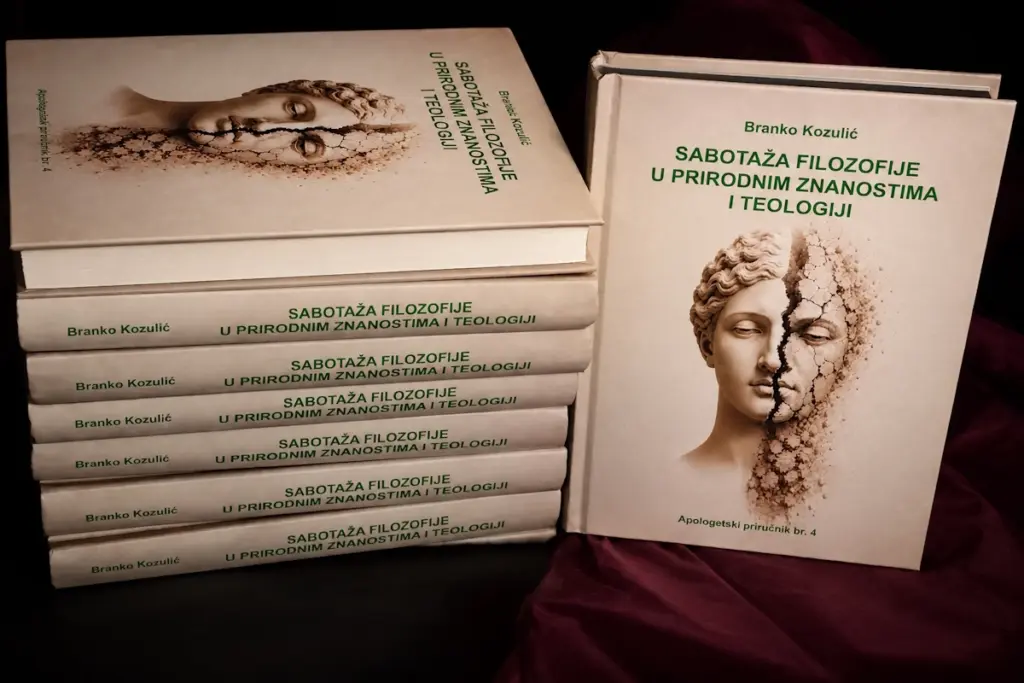
Main novelties and contributions of the work
The book brings an important shift in the contemporary dialogue between natural sciences, philosophy, and theology.
The discovery of unique proteins as an “ontological wall”
One of the most important novelties in the book is the introduction and elaboration of the discovery of unique proteins (singletons or taxonomically restricted genes), which the author interprets as an insurmountable “ontological wall” between biological species. Using the latest data obtained from sequencing the deoxyribonucleic acid of tens of thousands of genomes, Kozulić shows that each biological species has hundreds to thousands of genes and proteins that are completely unique and do not exist in any other biological species. These proteins constitute an essential species difference (differentia specifica) and within the living world form an ontological wall that cannot be bridged by the assumed gradual accumulation of small and random mutations, which directly challenges the classical evolutionary narrative of uninterrupted continuity and the gradual transition of one species into another.
Correction of error about equalizing motion and change
The author brings an important conceptual and methodological correction to the widespread misconception about equating movement and change (p. 31).
He explains exhaustively how motion in itself does not necessarily mean a change in the nature or structure of an entity. He supports this with the fact that the operation of the most precise atomic clocks, as well as the stability of the solar system itself, is based precisely on regular, cyclical, and exceptionally stable motion that does not disrupt the essence and structure of the system.
Refutation of the principle of the transition from quantity to quality
Equally important is the work’s precise refutation of the materialist and evolutionary principle of the alleged “transition of quantity into quality”. Using clear examples from chemistry and stereochemistry – especially isomers and chiral compounds (stereoisomers) – Kozulić unequivocally proves that a change in the quality and properties of a substance does not necessarily require a change in the quantity (number of atoms). The same number and type of atoms, depending on their spatial organization and form, can form substances with completely different chemical and biological properties, thus overthrowing the fundamental tenets of dialectical materialism and classical Darwinism about quantitative accumulation as a source of new qualities.
Application of Bošković’s theory to the concept of space, time and matter
Finally, the novelty of the work is also evident in the creative application of Ruđer Bošković’s natural philosophy to contemporary problems of understanding space, time and matter. A coherent solution to the question of the nature of space and time is offered through Bošković’s teaching, according to which space and time are not absolute, independent and empty categories into which things are subsequently placed, but represent the very mode of existence (modus existendi) of concrete material things in their movement and interaction. Thus, matter in the most general sense is movement-space-time.
Contents and author’s motto
The book has a guiding thought by St. Augustine (p. 4), Table of Contents (p. 5–7), Prologue (p. 8–10), Editor’s Note (p. 11–13), the first unit Science and Opposing Philosophical Postulates (p. 14–59), the second unit The Conflict of Philosophies (p. 60–195), Conclusion (p. 196–198), Literature (p. 199–208), Index of Names (p. 209–211), Index of Terms (p. 212–219), and a Note on the Author (p. 220).
At the dedication, the book quotes St. Augustine’s thoughts on the courage of standing up for the truth:
“I will not be afraid to express my opinion. I would much rather be judged by the upright than be afraid of being bitten by the wicked… I would much rather be rebuked by anyone than praised by someone who is in error or who flatters. A lover of truth is not afraid of any rebuker. An enemy or a friend will rebuke him. Therefore, if an enemy attacks, he should be endured. If a friend errs, he should be taught. If he teaches, he should be listened to. A praiser who is in error confirms error, and a flatterer destroys in error.”
Conclusion
The book Sabotage of Philosophy in the Natural Sciences and Theology is an exceptionally valuable and original apologetic manual. Its greatest strength lies in the fact that, using the very proven facts of modern science, it demolishes the philosophical myths of modernism and processism, restoring the dignity of classical philosophy and logic as indispensable allies of theology and scientific truth.
Posted in Croatian on 3 October 2026
For further reading
Order information, introductory word by Dr. Ivan Poljaković and book contents
Pius X, encyclical Pascendi Dominici gregis (1907)
Pius XII, encyclical Humani generis (1950)
John Paul II, Message to the Participants in the Session of the Pontifical Academy of Sciences (1996)
Branko Kozulić, The Essence of Biological Species (2021)